Introduction
CEO succession is one of a board’s most consequential decisions. Although each transition is unique, broader market trends can reveal how organizations plan for succession, develop leadership pipelines, and select their next CEOs.
We analyzed CEO transitions among TSX 60 and S&P 500 companies over the past three years, focusing on three questions:
- How often do CEO transitions occur?
- Where do new CEOs come from?
- Is the profile of the typical CEO changing?
Key Takeaways
While every CEO transition is unique, the data indicated several consistent patterns in how boards approach succession, identify future leaders, and select new CEOs. Key findings include:
CEO turnover remains steady and most departures are planned: particularly in the U.S., where CEOs also tend to serve shorter terms, at median
Most organizations continue to favour internal successors: internal successors make up more than 70% of new CEOs, with the vast majority coming from operating roles within the organization
CEO demographics remain largely consistent year-over-year: incoming and departing CEO ages remain consistent, while women continue to make up a very small portion of incoming CEOs
Methodology
Data was sourced from ESGAUGE and includes CEO transitions among the TSX 60 and the S&P 500 companies. Transitions were classified based on effective date and grouped into the following periods:
- 2024 (January 1, 2024 – December 31, 2024)
- 2025 (January 1, 2025 – December 31, 2025)
- 2026 (January 1, 2026 – August 31, 2026)
This sample covers 151 CEO transitions in the S&P 500 and 18 CEO transitions in the TSX 60. Note that due to the smaller number of transitions within the TSX 60, year-over-year results may be more volatile compared to those observed in the S&P 500.
Topic #1 – How Often Do CEO Transitions Occur?
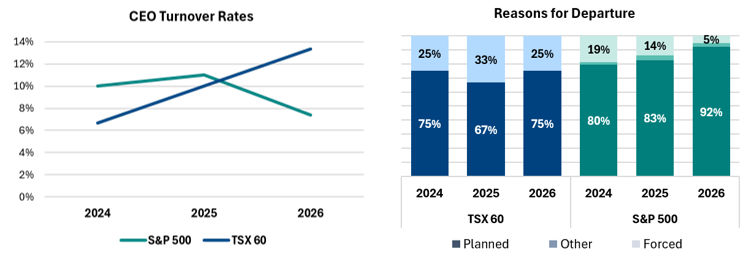
Turnover rates, measured as the proportion of companies experiencing a CEO transition in a given year, moved in different directions in Canada and the U.S. but remained within a relatively narrow range of approximately 7% to 13%. This translates to roughly a one-in-ten annual likelihood of a CEO transition. Although the annual rates appear steady, their cumulative effect is significant: over three years, a large-company peer group could replace approximately one-quarter to one-third of its CEOs. Boards should therefore treat succession readiness as an ongoing governance priority rather than an episodic exercise triggered by an announced departure.
One persistent trend is that planned departures, including retirements, are the most common, particularly in the U.S., where their share increased from 80% to 92% over the past three years. In Canada, forced departures were slightly more prevalent: in 2026, two of the eight CEO departures in the TSX 60 were forced, with both attributed to underperformance. For this analysis, planned departures include retirements and other anticipated transitions, while other departures include those related to mergers and acquisitions, illness, or death. The Canadian results may reflect continued shareholder pressure on organizations during periods of underperformance, although the small number of annual departures warrants caution when interpreting year-to-year changes.
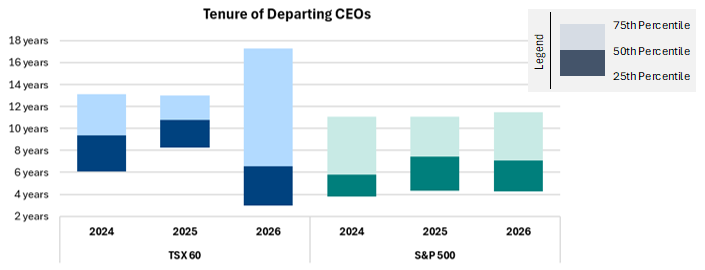
Over the past three years, the median tenure of departing CEOs was approximately seven years in the U.S. and nine years in Canada. In each year studied, Canadian CEOs typically served longer than their U.S. counterparts.
The roughly two-year difference in median tenure may also affect succession planning. Longer-serving CEOs can provide leadership continuity, but they may create fewer near-term opportunities to test internal candidates in the top role and increase the importance of maintaining credible emergency and longer-term succession options.
Key takeaway: CEO turnover remains steady and most departures are planned
Topic #2: Where Do New CEOs Come From?
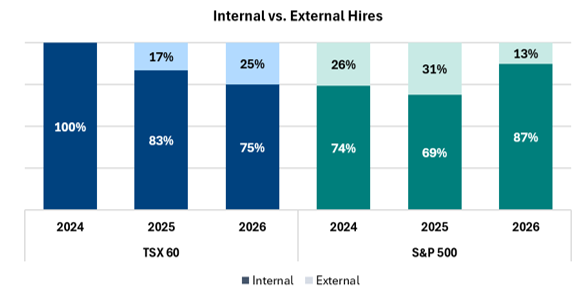
Boards continue to favour internal candidates for the CEO role. Internal hires accounted for 69% to 87% of appointments in the U.S. and 75% to 100% in Canada over the three-year period, underscoring the importance of internal succession planning and executive development.
The consistency of internal appointments suggests that boards are placing substantial weight on organization-specific experience and demonstrated performance. It also raises the stakes for leadership development: when the internal pipeline is narrow, a board may have fewer credible choices when a transition occurs unexpectedly.
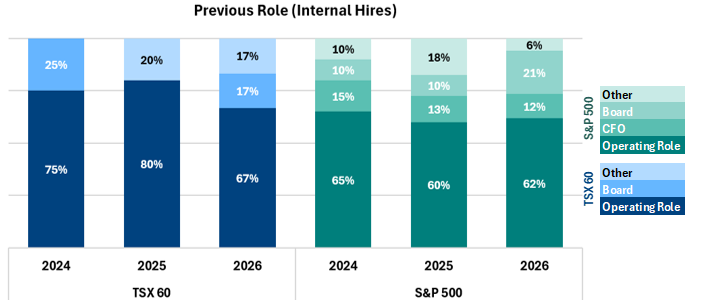
Among CEOs appointed internally, the vast majority were promoted from operating roles. In the U.S., CFOs also represented a meaningful, though declining, source of CEO appointments. Board members became significantly more prominent as successors in 2026, accounting for more than twice the proportion of internal appointments recorded in 2024 and 2025.
The predominance of operating executives suggests that boards continue to value direct business leadership and accountability for enterprise performance when selecting CEOs. Rotational assignments and broader business-unit responsibilities may therefore be important components of CEO development.
Key takeaway: Most organizations continue to favour internal successors
Topic #3: Is the CEO Profile Changing?
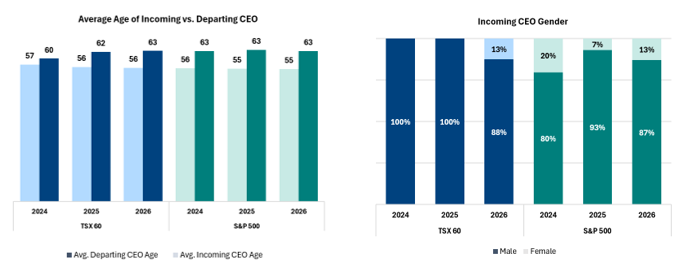
The average ages of incoming and departing CEOs were remarkably consistent across Canada and the U.S. over the past three years. Across North America, CEOs typically assumed the role between ages 55 and 57 and departed between ages 60 and 63.
The narrow age range for incoming CEOs also suggests that boards have not materially shifted toward either younger, earlier-career appointments or significantly more experienced late-career leaders. Despite changing business conditions, the market appears to retain a relatively conventional view of when executives are ready to assume the CEO role.
The overwhelming majority of new CEO appointments remained male in 2026. Although the proportion of women appointed as CEOs increased slightly in the most recent year, the TSX 60 recorded only one female CEO appointment over the three-year period. In the S&P 500, women accounted for between 7% and 20% of new CEO appointments over the same period.
The persistence of this imbalance suggests that progress at the CEO level depends partly on the depth and visibility of women in the senior operating roles from which most internal successors are selected. Boards should assess both the diversity of current succession slates and access to the operating assignments that develop credible CEO candidates.
Key takeaway: CEO demographics remain largely consistent year-over-year
About The Authors
Anqi Xu, Consultant & Lily Hoerath, Analyst
Anqi is a Consultant at Southlea Group, where she leads the Compensation Governance team.
Before joining Southlea Group, she served as Associate Vice President at ISS, a global proxy advisory firm, where she produced independent shareholder meeting research reports with voting recommendations for institutional investors. She also acted as the Canadian research team’s Environmental & Social (E&S) lead, specializing in E&S shareholder proposals.
Anqi has also held the position of Vice President, Governance Advisory at Kingsdale Advisors, a leading Canadian strategic advisory firm, where she advised boards and committees on complex corporate governance matters, including proxy contests and mergers and acquisitions. She provided strategic advice to public companies on executive compensation and was instrumental in several successful Say on Pay turnarounds.
Anqi brings extensive experience in assessing executive compensation frameworks and facilitating effective disclosure for publicly traded companies, particularly those listed on the S&P/TSX Composite Index, across multiple industries.
Prior to joining Southlea, Lily was an analyst at a multinational CPG company and worked in underwriting for a major global finance and insurance corporation.
She has over a year of experience supporting companies with various compensation challenges, including peer group development, competitive benchmarking of executives and board members, and incentive design.
Lily has experience working across various sectors including financial services, asset management and consumer services.