Canadian asset managers are showing more restraint on salary increases while giving incentive plans greater room to reward strong performance. Southlea’s 2026 survey points to a market where fixed-pay growth is moderate, incentive outcomes are relatively stable, and maximum opportunities are beginning to increase after years of focus on limiting variability.
Southlea’s 2026 Canadian Asset Management Compensation Survey draws on data from 47 organizations and covers salaries, incentives, and total compensation across investment and non-investment roles.
The 2026 survey included 47 organizations from across the industry, with median assets under management (AUM) of $19.0 billion and a range of $1billion to $1 trillion. Participants employed an average of 481 people, ranging from firms with fewer than 20 employees to institutions with more than 1,000. Pension funds represented 55% of participants, independent asset managers 32%, and other captive asset managers 13%.
Designed specifically for Canadian investment organizations, the survey captures compensation information across 12 job families, 50 disciplines, and 12 career levels, spanning operational and administrative positions through to investment professionals and senior executives. To support meaningful comparisons, positions are reviewed using a standardized framework that considers responsibilities, reporting relationships, organizational context, and supporting documentation to ensure consistent job matching across participants.
Standard survey results are reported across three key perspectives: all participants, larger asset managers with more than $50 billion in AUM, and smaller asset managers with less than $50 billion in AUM. This approach allows organizations to evaluate compensation practices relative to peers that share similar scale and operating characteristics.
Key Themes Emerging from the 2026 Results
The 2026 survey reveals a compensation landscape that continues to evolve in response to changing organizational priorities and talent market dynamics. Most notably:
- Salary increases were moderate
- Larger organizations delivered higher incentive payout multipliers (vs. smaller)
- Actual payout multipliers were consistent across asset classes
- Incentive upside continues to increase
Finding #1: Salary increases were moderate
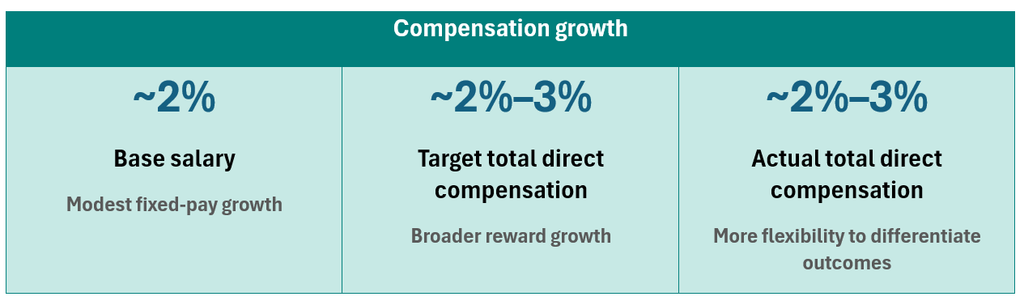
One of the most notable findings from the 2026 survey was the relatively modest level of base salary growth observed across participating organizations.
Average base salaries increased by approximately 2% across jobs in the standard survey samples. Growth remained positive but was somewhat lower than in recent years.
Moderate salary growth suggests that organizations remain cautious about adding fixed costs. Because salary increases carry forward regardless of future performance, larger adjustments are more likely to be reserved for market gaps, retention concerns, or meaningful expansions in role scope.
We may also be seeing a reflection of the maturity of compensation structures within many participating organizations. Canadian asset managers and pension funds have historically maintained sophisticated compensation programs that regularly benchmark pay against market levels. Where salary positioning is already competitive, large annual adjustments would not be necessary to maintain market alignment.
Increases for investment professionals and employees within smaller organizations generally lagged broader averages, suggesting that salary growth was not distributed evenly across all segments of the market, but targeted at where it’s needed most.
Finding #2: Larger organizations delivered higher incentive payout multipliers than smaller organizations
While salary increases were relatively consistent across the market, there was a distinction when examining actual incentive payout multipliers.
This year, generally consistent with last year, participants with more than $50 billion in AUM reported average actual incentive payouts equivalent to approximately 1.4x target incentive opportunities. By comparison, organizations with less than $50 billion in AUM reported average payouts of 1.2x target.
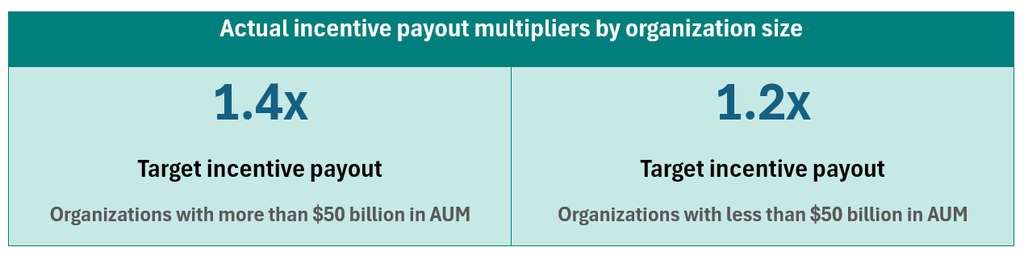
Smaller organizations tend to have lower incentive plan maximum opportunities (as a multiple of target) and a more quantitative approach to evaluating performance, both of which often result in lower pay in more challenging markets.
Actual payouts can substantially influence annual earnings, particularly for senior investment professionals whose compensation packages are often overweighted to incentives. Accordingly, differences in payout multipliers can have a meaningful impact on total compensation and overall competitiveness.
The findings also underscore why organizations should evaluate compensation positioning across all of target, actual, and maximum pay opportunities. Two organizations may offer similar targeted levels of compensation while delivering significantly different total pay outcomes through incentive program performance and upside potential.
From a workforce planning perspective, this dynamic may become increasingly relevant as organizations compete for experienced investment talent. Employees evaluating career opportunities should consider the full compensation package, including both target and potential incentive outcomes.
Finding #3: Actual payout multipliers were consistent across asset classes
Another notable finding from the survey relates to pay differences across asset classes.
Despite challenging performance conditions reported in some private market segments, the survey did not identify significant differences in actual incentive payout factors (as a multiple of target) across asset classes. This stability could be driven by multi-year performance evaluations, the inclusion of qualitative evaluation factors within plan designs, and potentially the use of overriding Board discretion to “floor” payouts for those experiencing challenging market conditions. Pension funds tend to offer more stability in pay outcomes from year to year, with fewer high-highs and low-lows than other investment sectors, and a philosophy that they are all performing as one team.
Meaningful differences in target and actual pay levels continue to exist among investment roles. On both a target and actual pay basis, investment professionals working within Infrastructure, Private Credit, and Private Equity earned compensation levels approximately 20% above those observed for the average investor role. Private market investing often requires highly specialized technical knowledge, distinct sourcing capabilities, and complex transaction experience, which tend to carry a pay premium.
Compensation professionals working with broad “investment” compensation bands will need to understand where premia and discounts may exist in order to properly position roles within the overall structure.
Finding #4: Incentive upside continues to increase
Perhaps the most significant theme emerging from the 2026 survey is the continued expansion of incentive upside opportunities.
For several years, many investment organizations have focused on balancing pay-for-performance objectives with a desire to reduce excessive compensation volatility. The 2026 data suggest that this trend may be evolving.
Across participating organizations, maximum incentive opportunities increased from 2.0x target incentive levels to 2.2x. Among Canada’s largest pension organizations, maximum opportunities reached approximately 2.3x target, driven by incentive plan changes at several participants.
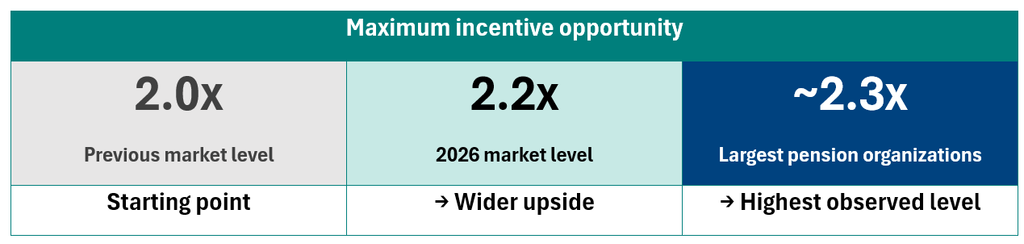
A higher maximum gives employees more earning potential in strong years and gives organizations more room to recognize exceptional results without permanently increasing pay.
Instinctively, higher upside potential should align with greater variability in individual outcomes (both upward and downward from target). It will be important for organizations with higher maximum opportunities to maintain discipline in evaluating what is truly exceptional, so as not to artificially inflate pay simply by raising maximums.
About The Author
Henry McMann, Consultant
Henry is a Consultant at Southlea Group. He has three years of experience providing analytical support on executive, director, and broad-based compensation projects.
He has experience supporting companies with various compensation challenges, including structure development, peer group development, competitive benchmarking, incentive design, job evaluation, and pay equity compliance. Henry has experience working across various sectors including financial services, asset management and consumer services.
Henry holds a Bachelor of Arts, Honours Business Administration from the Ivey Business School at Western University. Henry has passed the CFA Level I and II exams.