The following blog summarizes the say on pay voting results in Canada (among the TSX Composite companies) and the U.S. (among the S&P 500 companies) based on results as of July 20, 2026. It updates the early say on pay trends we shared in May. The data were collected by ESGAUGE, a data analytics firm.
Canada Results
At this point in the proxy season, 160 Canadian companies have reported their say on pay results for 2026. Median and mean voting results have remained steady over the last three years, while a higher proportion of companies received over 95% support compared with previous years.
Table 1 – Canada say on pay results

Chart 1 – Distribution of Canada say on pay results
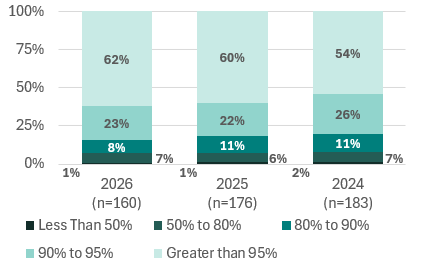
As shown in Chart 1, 62% of companies received over 95% support, 23% received 90% to 95% support, 8% received 80% to 90% support, 7% received 50% to 80% support, and one company (Allied Properties) failed year to date.
Canadian say on pay support in 2026 to date shows notable sector divergence: Energy (96%) and Consumer Discretionary (96%) lead with the strongest support and largest year-over-year improvement, while Real Estate (89%) is the only sector below 90% and continues a three-year decline. Information Technology has shown the strongest recovery, climbing from 78% in 2024 to 90% in 2026.
The year-over-year change in average support was partially influenced by changes in index composition, including the removal of certain companies that experienced significant declines in shareholder support. For example, Enghouse Systems Limited’s say on pay support fell from 76% in 2025 to 52% in 2026. The AGAINST recommendations from proxy advisors on its say on pay vote were extended to its compensation committee members. The company triggered proxy advisors’ 80% thresholds for board responsiveness but did not address shareholder feedback or enhance pay design disclosure, which was particularly significant given its sharp performance decline relative to the indices.
Of the reporting companies, 88% reported results that changed by less than 10 percentage points year-over-year. Table 2 highlights companies with year-over-year changes of more than 10 percentage points in say on pay support, separating increases and decreases to show where shareholder sentiment shifted most meaningfully.
Table 2 – Large year-over-year changes in say on pay voting results
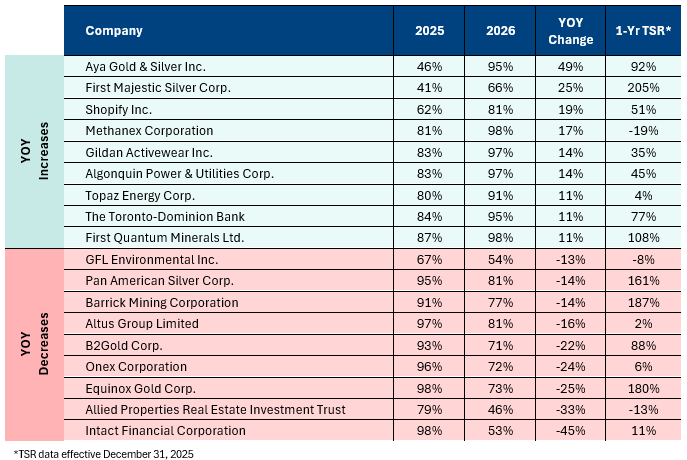
Compared with the mid-May results, GFL Environmental, Pan American Silver, and B2Gold have been added to the list of largest year-over-year declines, with support falling by up to 22 percentage points. Aya Gold & Silver, First Majestic Silver, Shopify, and Algonquin Power & Utilities have also been added to the list of largest increases, with support improving by 14 to 49 percentage points. Notably, Aya Gold & Silver and First Majestic Silver both rebounded from failed say on pay votes last year, with Aya Gold & Silver showing a particularly strong turnaround.
Aya Gold & Silver’s low say on pay support last year was primarily driven by a one-time retention-focused option grant, which contributed to a more than 400% year-over-year increase in CEO pay. This year, the company did not issue any one-time awards and added PSUs to its long-term incentive plan (LTIP), further strengthening the rigor of its pay design.
First Majestic also responded to shareholder feedback by signing a new employment agreement with its CEO. The agreement changed the company’s change-in-control provisions by capping severance payments and removing the legacy single-trigger provision, while also increasing the share ownership requirement and reducing the CEO’s base salary by approximately 12%.
For details on Intact and Allied REIT, which experienced the largest declines in say on pay results, please refer to our May blog for additional context.
U.S. Results
In the U.S., the average support level among S&P 500 companies that reported as of July 20, 2026, increased slightly compared with prior years’ results, as shown in Table 3.
Table 3 – U.S. say on pay results

Chart 2 – Distribution of U.S. say on pay results
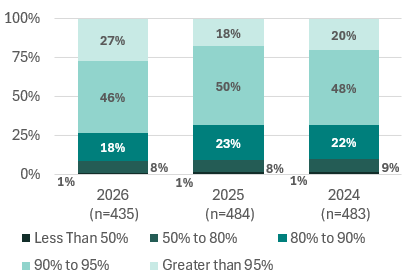
As illustrated in Chart 2, the percentage of companies garnering more than 95% shareholder support climbed from 18% to 27%. Year to date, five companies have failed the say on pay vote, compared with seven for full-year 2025.
U.S. say on pay support in 2026 to date shows Energy (95%) and Materials (94%) leading all sectors, while Communication Services (74%) lags well behind, down from 86% in 2025. This decline was partially driven by Warner Bros. Discovery, Inc.’s exceptionally low support level of 16%. Real Estate continues a three-year decline, from 92% in 2024 to 85% in 2026, and Industrials shows the strongest improvement, rising from 88% in 2024 to 93% in 2026.
ISS STOXX 2026 Annual Global Benchmark Policy Survey
Looking ahead to the proxy voting season next year, ISS STOXX (ISS) launched its annual global benchmark policy survey on July 21, 2026. This survey helps inform potential policy changes for the coming year and provides an indication of potential focus areas for ISS and institutional investors. For the Canadian and U.S. markets, topics related to executive compensation are listed below:
- Say on pay and board responsiveness [Canada and U.S.]: In the absence of a say on pay vote, ISS is revisiting the director election threshold used to assess board responsiveness to compensation-related concerns, such as whether it should align with the say on pay responsiveness threshold (70% in the U.S. and 80% in Canada).
- Say on pay [U.S.]: Recent SEC rules issued in May 2026 simplified company filer status and public disclosure requirements. For companies exempt from say on pay votes, ISS is seeking feedback on how it should signal significant compensation concerns in the absence of a say on pay vote.
- Discretionary bonus programs [U.S.]: The survey focuses on large U.S. financial services companies, where bonus programs are often determined through committee discretion. ISS is asking whether highly discretionary short-term incentive programs should continue to be viewed as a governance concern in this sector, and if so, what disclosure would be sufficient to address that concern.
- Long-term incentive performance goal disclosure [U.S.]: Many issuers do not disclose LTIP targets, citing potential competitive harm. ISS is soliciting views on whether competitive harm is a compelling rationale for non-disclosure, and whether the non-disclosure of relative goals raises greater concern than the non-disclosure of absolute goals.
About The Author
Anqi Xu, Consultant
Anqi is a Consultant at Southlea Group, where she leads the Compensation Governance team. Before joining Southlea Group, she served as Associate Vice President at ISS, a global proxy advisory firm, where she produced independent shareholder meeting research reports with voting recommendations for institutional investors. She also acted as the Canadian research team’s Environmental & Social (E&S) lead, specializing in E&S shareholder proposals.
Anqi has also held the position of Vice President, Governance Advisory at Kingsdale Advisors, a leading Canadian strategic advisory firm, where she advised boards and committees on complex corporate governance matters, including proxy contests and mergers and acquisitions. She provided strategic advice to public companies on executive compensation and was instrumental in several successful Say on Pay turnarounds.
Anqi brings extensive experience in assessing executive compensation frameworks and facilitating effective disclosure for publicly traded companies, particularly those listed on the S&P/TSX Composite Index, across multiple industries.