Introduction
As we enter the time of year when companies begin assessing performance against their annual goals for the current year and defining goals for the coming year, an important consideration is whether senior executives should be rewarded for their individual contributions.
Individual objectives for senior executives should be set regardless of whether they are explicitly linked to pay outcomes, cascading appropriately from corporate priorities and reflecting each executive’s specific responsibilities. A separate decision is whether the assessment of individual performance should differentiate senior executive pay levels.
In this article, we focus on individual performance in the short-term incentive plan (STIP) – the rationale for and against its inclusion, alternative mechanics for inclusion, whether it delivers the intended differentiation in STIP awards, and best practices for goal setting and performance assessment. Market insights have been summarized for companies in the S&P / TSX Composite Index, collected by ESGAUGE, a data analytics firm.
Key Takeaways
- For senior executives, the rationale for individual performance inclusion in the STIP depends on the role and corporate plan objectives: individual goals remain important whether or not they are directly linked to pay – a separate component for individual goals is more relevant where the overall corporate measures / scorecard do not capture broader contributions and where accountability of individual executive roles is a priority
- Goal calibration matters as much as the design: the form of the individual component (i.e., additive / weighted measure, multiplier / modifier, or discretion) can affect the overall impact and pay outcome. Other influences include the relative weight of the individual component, the quality of individual performance measures (if targets and ranges are well defined), and how performance is assessed (quantitative vs. qualitative)
- Use of an individual component does not automatically deliver pay differentiation: an advantage of an individual component is the flexibility to differentiate STIP awards to recognize personal contributions. Our review of market practices suggests CEO and senior executive actual STIP awards are often similar to the corporate scorecard result. The impact of individual performance is modest and typically upward, raising the STIP payout
- Goal-setting and assessment determine how the design works in practice: if an individual component is used, clear expectations, a structured annual assessment process, and full use of the available performance range (where warranted) will better support meaningful differentiation. If the individual component has minimal impact on STIP awards, there may be merit to removing
The Rationale For and Against Incorporating Individual Performance
The decision to include a direct link between individual performance and STIP awards should be principles-based. There is increased rationale where role-specific contributions are not captured by the corporate scorecard and a portion of the STIP is intended to reinforce individual accountability.
Consideration
Incorporation of individual performance in the STIP
Rationale FOR
Rationale AGAINST
Role-specific responsibilities
- Senior executive role has clear and distinct business unit or functional responsibilities / goals
- Role has specific goals linked to transformation milestones or major projects which are not well captured by company-wide STIP goals
- Executive’s responsibilities closely align with company-wide results
- Corporate scorecard measures effectively capture the outcomes of individual contributions
Breadth of the corporate scorecard
- Corporate scorecard is predominantly or entirely financial measures
- Desired to measure and reward “drivers” of performance, in addition to performance outcomes
- Scorecard includes a broad mix of categories / measures (i.e., financial, operating, strategic)
Teamwork and individual accountability
- Emphasis on individual accountability, and ownership of specific priorities
- Preference for differentiation of STIP awards among senior executives
- Emphasis on senior executive teamwork and collective results
- Preference for no differentiation of STIP awards among senior executives
The decision to include an individual performance component may differ by role or executive level. For example, the corporate scorecard results may effectively recognize CEO performance, but not other senior executive roles. Or the corporate scorecard works well to reward teamwork among the executive leadership team, but an individual component is necessary for other executive levels and the broader workforce.
Inclusion may also be “point in time”. For a newly appointed CEO, and individual component can be a helpful tool for the Board to clarify goals, collect and share feedback, and send a signal as the new CEO incumbent develops in the role.
Institutional shareholder guidance offers limited direction on the use of individual performance to adjudicate pay. Glass Lewis states in its 2026 Canadian Benchmark Policy Guidelines that wherever possible, a mix of corporate and individual measures is appropriate, provided measures are appropriately tied to a company’s business drivers. Institutional Shareholder Services (ISS) and the Canadian Coalition for Good Governance (CCGG) do not reference individual performance explicitly – instead, ISS emphasizes general pay-for-performance alignment and CCGG favours measures within management’s control that align with the corporate strategy.
Design Alternatives
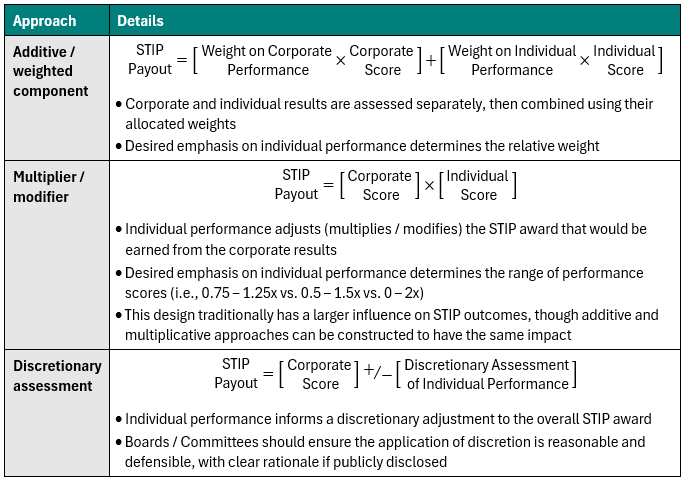
Individual contributions can be recognized in multiple ways (e.g., salary increases, long-term incentive grants, participation in special projects, training and development). Within the STIP, the typical ways to reward individual contributions are through an additive / weighted measure, a multiplier or modifier, or a discretionary assessment. Each design alternative links individual achievement to the STIP payout in different ways, with different calibrations and interactions with corporate performance outcomes:
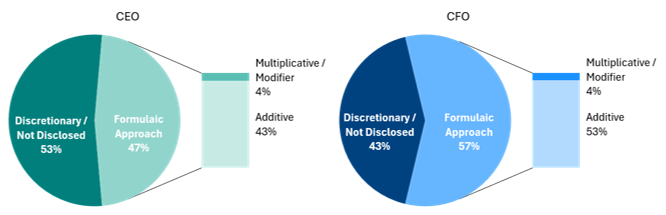
Reviewing practices among the S&P / TSX Composite Index, Chart 1 shows ~50% of companies explicitly include an individual performance component in their CEO STIP design – defined a “formulaic approach”. For CFOs, prevalence increases to ~60%. Formulaic approaches include additive designs and multiplier designs, with additive being most common. The other companies are grouped as having the flexibility to recognize individual performance using discretion, or their practice is not clearly disclosed.
Chart 1: Individual Performance Incorporation Approaches
In Chart 2 we observe a decrease in prevalence of a formulaic individual performance components as company size increases.
Chart 2: Individual Performance Incorporation Approaches by Company Revenue
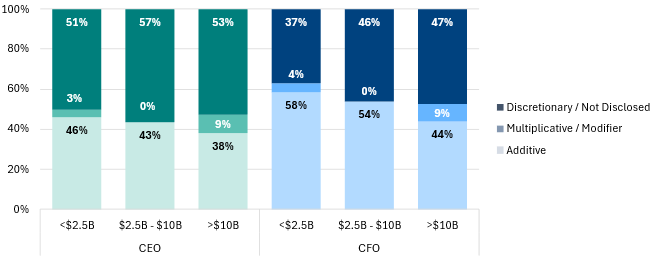
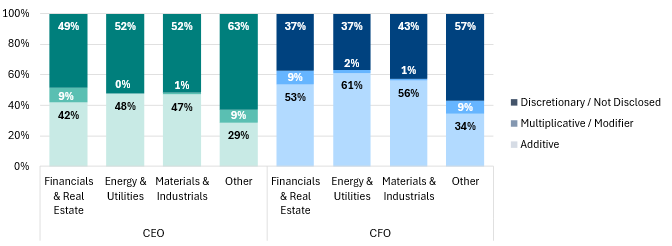
Chart 3 compares the use of individual performance components across sectors, based on the Global Industry Classification Standard (GICS). Similar sectors are bundled together. Where sample sizes of individual sectors are smaller (< 5%), the “Other” sector includes Communication Services, Consumer Discretionary, Consumer Staples, Health Care, and Information Technology.
While prevalence is broadly similar across the sectors reviewed, the group of “Other” sectors had a lower usage of individual performance in the STIP. This may be explained by the use of broader corporate scorecards in these sectors, with performance categories / measures that effectively capture individual performance contributions, or a desired emphasis on teamwork (and less emphasis on individual goals).
Chart 3: Individual Performance Incorporation by Company Sector
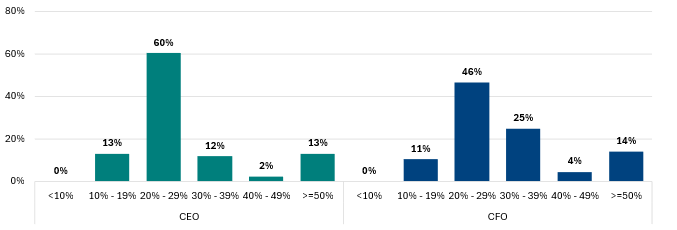
Focusing on additive STIP designs with a weighted individual performance component, the median and most prevalent weights are 20% for CEOs. For CFOs (representing other senior executive roles), weights vary, with a median of 25% and the most common weight being 30%. Weights continue to cascade to other position levels in the organization (e.g., 35 – 40% weight for the broader executive team, and >40% for the broader workforce). Chart 4 summarizes the full distribution of weights among additive STIP designs.
Chart 4: Distribution of Individual Performance Weights in Additive STIP Designs
Though multiplicative / modifier designs are less common, maximum individual multipliers range from 1.1x to 1.5x the corporate score for both the CEO and CFO. The median maximum is 1.2x for CEOs and 1.35x for CFOs. The most common maximum is 1.5x for both roles.
Impact on STIP Payouts
The framework and relevant parameters (e.g., additive weights or multiplicative ranges, and individual performance measures) influence the flexibility to differentiate STIP awards. It is also important that Boards / Committees then assess whether this flexibility is being used effectively to differentiate pay as intended.
Chart 5 shows the impact of individual performance on CEO STIP payouts where there is an explicit individual component (additive or multiplier design). The Chart reviews the difference between CEO FY2025 STIP payouts (% of target) and the corporate scorecard score (% of target).
Results show the impact was modest, between -5% and +5% for ~55% of CEOs, including ~15% where there was no difference in scores. Where individual performance had an impact, there were examples of lower and higher scores, with a bias to higher scores.
Chart 5: Difference Between Overall CEO STIP Payout and Corporate Scorecard Result
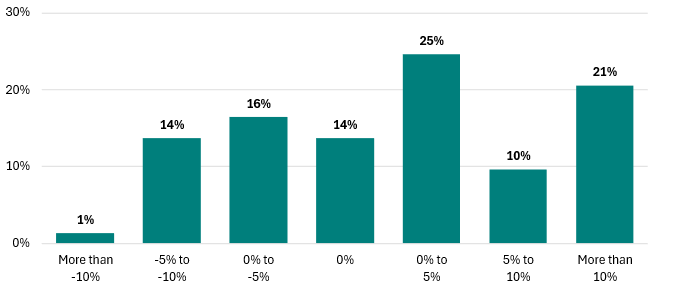
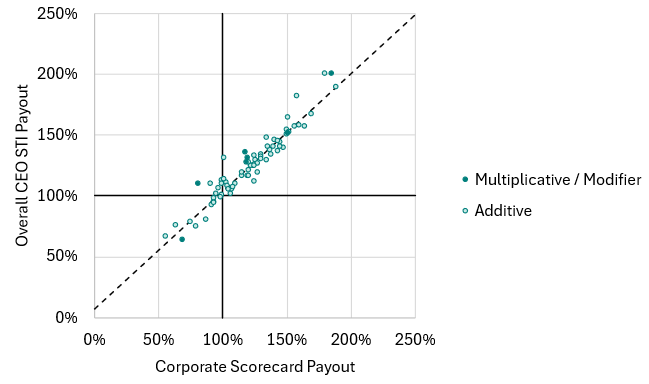
Chart 6 plots the individual observations underlying Chart 5, comparing each CEO’s overall STIP payout with the corporate scorecard result. Most points lie on, or close to the diagonal line where the two outcomes are equal (the equivalent of the zero-difference bar in Chart 5). Most CEO STIP awards were above target (>100%), and differences from the corporate score were most often higher.
Chart 6: Overall CEO STIP Payouts vs. Corporate Scorecard Results by Incorporation Approach
Lessons for Individual Performance Goal Setting
Some companies may prefer the relative impact of individual performance on STIP payouts to be modest, with limited differentiation among the senior executive team. But if there is a preference to increase the relative impact, goal setting and performance calibration is the answer. The following practices can help ensure the individual component has a meaningful impact:
- Cascade goals from company priorities: ensure individual goals are specific to the senior executive role, with the ability to directly influence goal achievement. Goals should be aligned with, but different from corporate objectives, which will avoid rewarding for the same performance outcome in the two separate components
- Define performance achievement: decide and communicate the performance goal, weight, measure, and performance range if possible – this may be specific anchors for threshold / target / maximum performance, or simply a target with flexibility to assess performance around target
- Discuss progress during the year: address shifts in priorities or significant changes to business conditions (e.g., strategic, macroeconomic, etc.) that affect goal achievement, instead of waiting until year-end
- Use the full performance range where warranted: assess performance against the agreed expectations, including threshold and maximum performance scores where justified. The overall STIP calculation moderates the effect of individual performance as other performance elements are incorporated – an individual performance score that appears substantial in isolation may have a modest impact on the final STIP award
- Review outcomes after payouts: assess whether the individual component affected the STIP design as intended, including desired behaviours (e.g., encouraging individual ownership over teamwork) and STIP payouts. Review and redesign the individual component as needed
Assessing Individual Performance in Practice
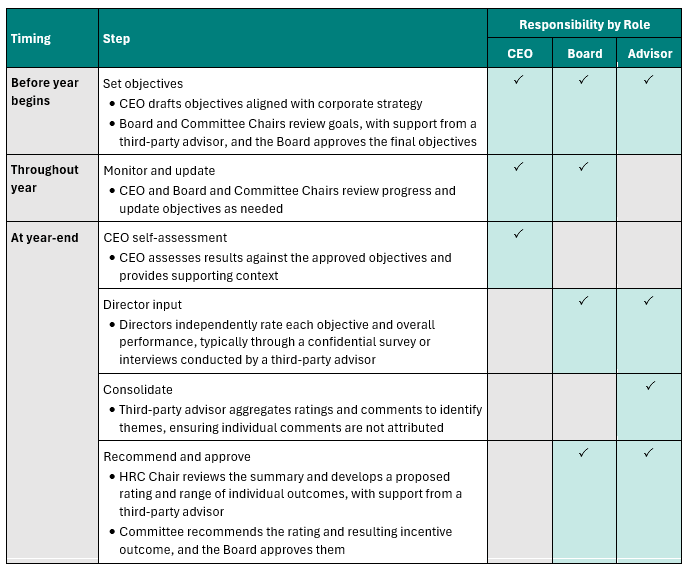
Individual performance assessment is a critical process. Best practices include setting objectives before the start of the year, monitoring and updating during the year, and collecting and sharing feedback at year-end. Use of an independent advisor can aid the process, particularly for CEO performance assessment, by maintaining confidentially of feedback shared by individuals, and reducing bias in the feedback summary.
The table below outlines the recommended annual assessment process for a CEO. For other senior executives, the CEO typically leads the assessment, with Human Resources Committee (HRC) review.
About The Authors
Caroline Marshall, Consultant
Caroline is a Consultant at Southlea Group with five years of experience.
Prior to joining Southlea Group, she worked as an Associate at a large, global multi-service consulting firm, providing analytical support on executive and broad-based compensation projects.
She has experience supporting companies with a variety of compensation-related initiatives, including total rewards philosophy and peer group development, competitive benchmarking of board, executive, and broad-based pay, short- and long-term incentive plan design, and governance of compensation programs.
Caroline has experience working across many sectors, including financial services and Canadian pension plans.
Caroline has an Honours Business Administration degree from Wilfrid Laurier University and an Honours Mathematics degree from the University of Waterloo.